

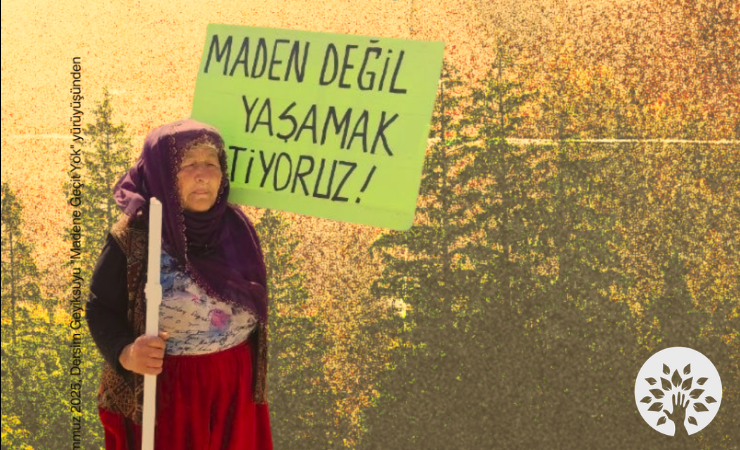
Here is the summary of our report “Struggle Against Extractivism in Turkey”.
You can reach the Turkish version of the report form here. It will soon be translated into English.
Extractivism cannot be defined solely as the mere excavation of vast areas for mineral exports and the abandonment of deep, toxic pits beyond rehabilitation. This political concept represents far more than an environmental category: The term describes capitalism’s method of relating to the world and the appropriation of nature by capital. It is an activity that enables the transfer of not only materials, but also energy and labor, from extraction zones to the dominant centers of capitalism. Within this context, extractivism transcends mere economic activity: Dispossession, the seizure of the commons, extra-legal practices, and labor exploitation originate from colonial history and remain inseparable from extractivism. Human rights violations, the commodification of social relations, the erosion of democracy, authoritarian regimes, and war politics feed one another.
With this report, we aimed to “pull the emergency brake” to demonstrate the extent to which extractivism threatens our living spaces, our diverse values, collective life, other living species, and the Earth as we know it. The degree to which we achieve this goal will depend on the level of reader participation in the struggle.
In the ‘Introduction‘ section of the report, which we dedicate to our comrade Hakan Tosun, we recall the ‘Life is More Valuable Than Gold’ campaign launched in 2024 and state that the monitoring of gold mining projects, which plays a significant role in the Polen Ecology Collective’s work against extractivism, illuminated the preparation of this report. In the ‘Aim’ section, after establishing a connection between extractivism, war politics, the ‘super permit law’ enacted in July 2025, rare earth elements, and hydraulic fracturing, we explain in the ‘Scope‘ section how we considered MAPEG (General Directorate of Mining and Petroleum Affairs) tenders, the ‘non-tendered’ license transfers of the Real Estate Commission, and Environmental Impact Assessment (EIA) projects in the report, and how we used concepts inherent to extractivism such as ‘sacrificed areas’ and ‘mega mines’.
The section titled ‘The Concept and Characteristics of Extractivism’ includes a detailed examination of the definition and character of extractivism provided above. This is followed by ‘The Economic Dimension of Extractivism,’ a critique of narratives of ‘development, wealth, and economic growth,’ and a preliminary discussion towards solutions, along with the identification of extractivism as a style of ‘appropriation, not production.’
The section titled ‘Three Manifestations of Extractivism’ presents data and findings on the direction of rare earth element mining in Turkey, along with an explanation of the application of ‘hydraulic fracturing’ in oil/natural gas exploration/extraction initiated in Diyarbakır and Thrace, and the extent and destructive consequences of ‘cyanide gold mining,’ which has surged in recent years. Under the heading ‘Socio-Environmental Destruction of Extractivism’, the section addresses toxic waste, acid-rock drainage, excessive water consumption, biodiversity destruction, devastation of plant and animal production, threats to food sovereignty, and the phenomenon of ‘depeasantization’ as a social catastrophe.
The section titled ‘A Look at the Recent History of Mining in Turkey’ examines mining activities in Turkey historically from 1900 to 2026 in four periods, focusing specifically on major mining operations (Balıkesir Balya lead-zinc mine, Zonguldak coal mine, Ergani copper mine, Guleman chromium deposits, Divriği iron deposits, Bergama gold mine, Kazdağları gold mine, İkizdere quarry, Akbelen forest and coal mine, Çöpler gold mine, the We Won’t Give Away Our Land movement) and describes the devastation that those mines have been causing.
In the section titled ‘Legal Critique of the Functioning of Extractivism’, recent legislative changes, the functioning of the EIA process, and the decisions of the real estate commission are examined in terms of their compliance with the constitution, environmental law, and public interest, and the instrumentalization of law for the smooth functioning of capital is criticized in various contexts.
Under the title ‘Mining Companies‘, the study focuses on the companies that have acquired the majority of mining licenses and carried out the most EIA projects in recent years; the mining licenses/projects/operations of these companies, the activities of the holding companies in sectors closely related to extractivism such as energy, construction and logistics, export data of the most extracted minerals, global war budgets, and critical minerals are examined with maps and graphs.
In the ‘Extractive Waste’ section, the fact that far more soil is turned into waste than the extracted and enriched minerals is documented with figures, emphasizing that the main activity of mining, which is often overlooked, is ‘turning natural resources into waste dumps.’ It is stated that the significantly increased amount of waste in Turkey in recent years is proof of the dramatic growth of mining, and the aftermath of the huge amounts of toxic waste each year is interrogated.
The section titled ‘Accidents and Labor Exploitation’ explains the concept of ‘laborology’ and presents ‘workplace fatalities,’ another dark side of extractivism, using data from the Occupational Health and Safety Council (ISIG) covering the last 13 years. In Turkey, where an average of 100 people die each year in workplace fatalities in mines, with the majority of deaths occurring in coal, marble, and quarries, the chapter questions how much these numbers will increase due to the mining policies that persist in multiplying the coal mines while constantly loosening regulations, and because mining licenses are proliferating across the country.
The graphs and tables presented in the section ‘Mining Extraction in the World and Turkey, Export/Import Data and Interpretations’ reveal that extractivism is a completely global phenomenon, that it is closely related to the capitalist production-consumption processes, and demonstrate Turkey’s export-oriented mining policy. A critique of the data is also included, both on a global scale and on a Turkish scale.
In the section titled ‘Green Colonialism and Green Extractivism ’, green colonialism is criticized for exploiting natural resources beneath the ground, energy, and labor under the guise of a transition to clean energy, deepening capitalist property relations, while green extractivism critiques the justification of mining for renewable energy power plants. The section on ‘Urban Extractivism’ links this concept, which originated in South America and is still being developed, to the right to the city: it establishes metaphorical and direct connections between real estate capital, which commodifies large cities, seizes working-class neighborhoods, and generates rent through excavation and gentrification, and extractivism, which seizes living spaces in rural areas. It proposes building bridges between urban and rural struggles through the phenomenon of extractivism.
The section on ‘Organizing the Struggle’ emphasizes the importance of a united front and international solidarity against capitalism, imperialism, and patriarchy, as various forms of social exploitation, in the fight against extractivism. It outlines the steps of an ecosocialist transition program, offering concrete proposals including establishing communication networks, reclaiming agricultural lands through cultivation, and fostering solidarity within the boundaries set by nature.
The final and most comprehensive section of the report, ‘The Destruction of Mining by Province, ’ examines each province alphabetically, starting with Adana and ending with Zonguldak, using data and maps to cover the following sections:
Mining license tenders: The mining license tenders opened by MAPEG (General Directorate of Mining and Petroleum Affairs) from the beginning of 2023 to the end of 2025, and the areas sold to mining companies in these tenders, are presented with aggregate figures and maps showing the locations of the licensed areas.
Sales without tender: Licenses transferred to mining companies without tender, based on the decisions of the Real Estate Commission, and, further, at the request of the companies, are shown collectively on the provincial map for the period from the beginning of 2022 to February 2026. Information on the types of mines and the companies is provided.
Mining projects in the EIA process: The report presents aggregate figures and major mining types for EIA projects from the beginning of 2023 to February 8, 2026, along with data on the distribution of EIA decisions by district, decision type, and project owner.
Sacrificed Areas: The report shows “sacrificed districts” on a map, determined by evaluation of 13 separate criteria related to the multitude of mining licenses and projects.
Workplace Fatalities: Data on workplace fatalities from the Occupational Safety and Health Council (ISIG) for the period 2013-2025 is presented on a provincial basis.
We hope that the report, ‘Struggle against Extractivism in Turkey’, will reach a wide readership. Our expectation from urban readers is that they will evaluate the threats to rural living spaces and the proposed solutions presented in the report, and actively participate in organizing against extractivism. Furthermore, we hope they will be inspired by this stance against extractivism in the countryside to expand the struggle for the right to the city in their own living spaces.
We also hope that this report will contribute to the creation of a platform to address the aggressions of extractivism in Turkey.